Iran's Parliament Speaker Mohammad Bagher Ghalibaf gives a press conference at an event marking 40 days since the burial of the late Iranian supreme leader Ayatollah Ali Khamenei, at Imam Hassan al-Mujtaba Mosque in Iraq's central holy shrine city of Karbala on August 20, 2026.
Trump weighs ‘easy or hard’ option as Iran holds firm
Tehran reviews US diplomatic response as tensions mount over Hormuz and regional security
Last updated:
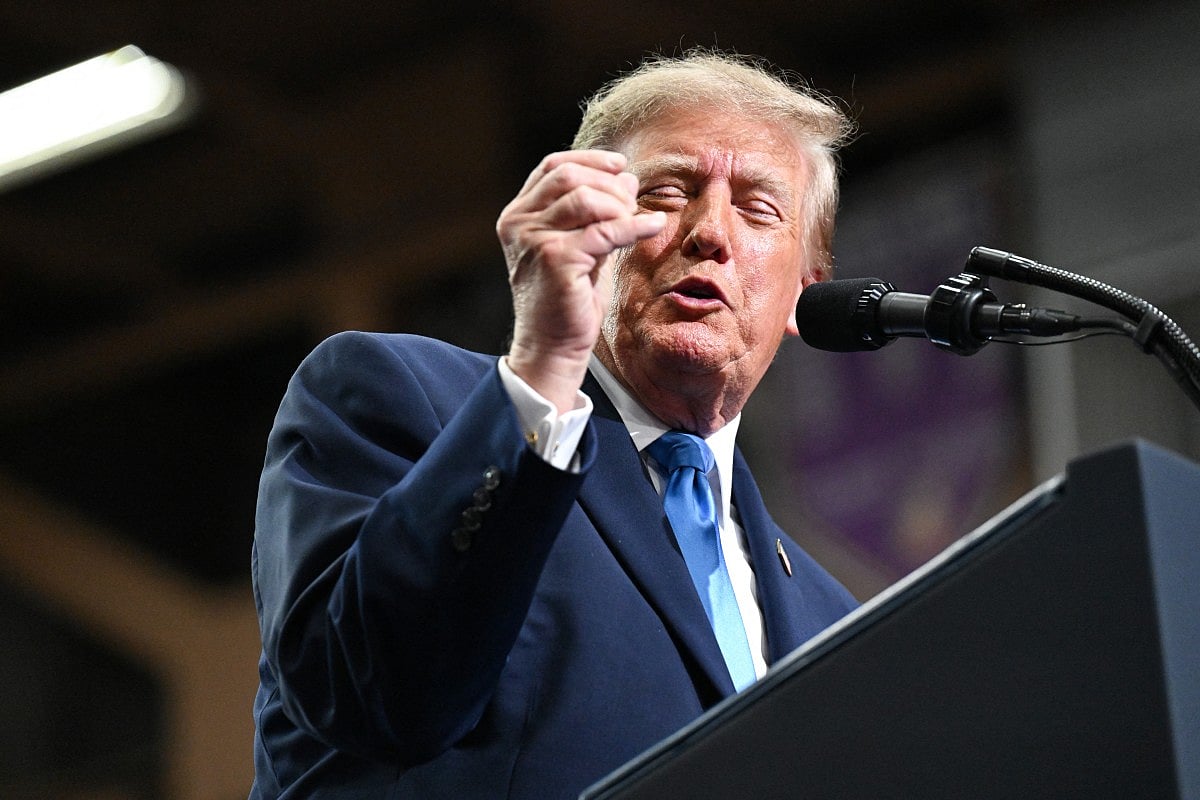
President Donald Trump speaks on stage at the Butler-Vandalia Student Activity Center during a campaign rally on October 03, 2026 in Vandalia, Ohio.
AFP
Tensions remain high as Trump weighs Washington’s next move against Iran, warning that a decision will come “the easy way or the hard way”. Tehran is reviewing a US response to its diplomatic proposal while insisting that Hormuz will remain closed until its conditions are met. Iran has also vowed to strengthen its missile capabilities. Elsewhere, Yemen’s conflict has intensified, with more than 70 people reportedly killed in fighting around Taiz and the Houthis claiming attacks on Saudi energy sites. Follow all the latest developments here:
US‑Israel war on Iran: Recent developments
Missile debris injures resident in Saudi Arabia's Asir
Saudi Arabia's Civil Defense said falling debris from an intercepted ballistic missile injured one resident in Ahad Rafidah Governorate, in the southern Asir region. In a post on X, the authority said the debris also damaged a prayer room inside a building, as well as several vehicles.
Get updated faster and for FREE: Download the Gulf News app now - simply click here.
Five Indians rescued after tanker hit by projectile in Strait of Hormuz
Five Indian nationals were brought safely ashore with assistance from Omani authorities after a Kuwait-flagged tanker was struck by a projectile in the Strait of Hormuz, according to the Indian Embassy in Oman.
The embassy confirmed on Friday that it had coordinated efforts to assist the crew members aboard the MT Kazimah III, working with authorities in Oman to ensure their safe evacuation.
Smoke, flames seen near Saudi Aramco facility in Riyadh
Flames and smoke were seen rising from a facility belonging to Saudi oil giant Aramco south of the kingdom's capital Riyadh on Saturday, an AFP journalist said.
The circumstances remained unclear but in recent weeks Aramco, majority-owned by the Saudi state, has come under attack from the Houthi group targeting the kingdom as part of the war in Yemen where Riyadh is backing the internationally recognised government.
The journalist reported seeing fire engines attempting to extinguish a blaze at the energy giant's Riyadh refinery, located south of the capital, while ambulances and police vehicles were stationed near the facility.
Both the Houthis and Saudi authorities had yet to comment on the incident.
Get updated faster and for FREE: Download the Gulf News app now - simply click here.
Yemen's Houthis claim attack on Aramco site in Riyadh
Yemen's Houthis claimed an attack against an Aramco site in the Saudi capital of Riyadh on Saturday, the group's media said.
Houthi military spokesman Yahya Saree said they targeted the site with ballistic missiles and drones. Earlier in the day, an AFP journalist reported smoke and flames rising from a facility belonging to the oil giant south of Riyadh.
Iran adopts ‘new arrangement’ as US sanctions intensify
Iranian President Masoud Pezeshkian said that his government had adopted a “new arrangement” to manage what he described as special conditions, as the United States steps up economic pressure and sanctions against Iran.
In a post on X, Pezeshkian accused the US and other adversaries of seeking to cut off Iran’s vital economic lifelines to pressure the Iranian people.
He said government measures and public support had so far prevented those efforts from achieving their objectives.
“The government has adopted a new arrangement to manage these special conditions,” Pezeshkian said, describing the intensified economic pressure as an “economic war”.
Trump says US will decide on Iran ‘easy way or hard way’
Trump said that Washington would soon make a decision on Iran, warning that the outcome would come “the easy way or the hard way”.
Speaking to reporters outside the White House, Trump said Iran had been “decimated” but did not provide details of his administration’s next steps.
“We have a decision that I’ll make about Iran. Iran’s been decimated. So the only question is, it’ll either be the easy way or the hard way,” Trump said.
Trump has continued to withhold details of his plans for Iran, saying the situation was developing favourably for the US.
Asked about his strategy on Friday, Trump suggested that revealing his plans would generate significant headlines.
“If I told you, you’d have a major story, right? But you’ll see. Working out very well. Iran is not doing well,” he said.
The US President did not give a timeline or outline specific measures his administration could take next.
Trump predicts quick end to conflict
Trump has previously said the war with Iran would end “very quickly” and predicted that oil prices would fall sharply once hostilities ended.
Speaking to reporters in Texas, he said Iran faced a choice over how the conflict would conclude.
“Iran will very soon be ending one way or the other,” Trump said.
He pointed to Iran’s economic and military difficulties, citing what he described as extremely high inflation and a lack of financial resources.
“And, one way or the other, it’s going to end very quickly. And when that ends, oil prices are going to drop like a rock,” Trump said.
Trump’s latest comments come amid continued US pressure on Tehran, with preventing Iran from obtaining a nuclear capability remaining a central US policy objective.
The President has not disclosed what further actions Washington may take or when a decision on Iran will be announced.
Iran’s Pezeshkian says economic pressure has failed
Iranian President Masoud Pezeshkian said the government has adopted a “new arrangement” to manage the country’s “special conditions”, while claiming intensified economic pressure has failed to achieve its objectives.
In a post on X, Pezeshkian said Iran’s government, backed by the public, had prevented what he described as an “economic war” from achieving its goals.
US President Donald Trump, meanwhile, said the war with Iran would end “very quickly” and predicted oil prices would fall sharply once the conflict ends. He said Iran faced severe economic and military pressure.
Get updated faster and for FREE: Download the Gulf News app now - simply click here.
US Senator Chris Murphy visits Qatar, Saudi Arabia amid Iran war
US Senator Chris Murphy has arrived in Qatar as part of a Middle East trip to assess damage from the US-Israel war on Iran and meet officials involved in efforts to end the conflict.
Murphy said on X that he would also travel to Riyadh, describing himself as the first Democratic senator to visit the region since the war began.
He said the trip would focus on assessing damage to US facilities, discussing the war’s impact and efforts to end the conflict with Qatari and Saudi officials, and considering future US policy towards the Gulf.
Iraq moves 2m barrels of crude through Strait of Hormuz
Iraq’s state-owned Oil Tanker Company has transported 2 million barrels of Iraqi crude through the Strait of Hormuz aboard a very large crude carrier (VLCC), in what the company described as its first such operation in decades.
The move allows Iraq to transport crude through the strait rather than delivering it at the port of Basra, giving state oil marketer SOMO greater flexibility over where and how it sells the oil.
Oil Tanker Company Director General Ali Qais Abdul Jabbar said the operation could help SOMO take advantage of better sales and pricing opportunities.
The company is also seeking to acquire specialised crude oil tankers to expand its fleet and strengthen its position among regional shipping operators.
Iraq has previously secured Iranian permission for its oil tankers to transit the Strait of Hormuz, which Iran has effectively closed amid its conflict with the US.
Get updated faster and for FREE: Download the Gulf News app now - simply click here.
Portugal probes US use of Lajes base in Iran war
Portuguese prosecutors have opened a probe into the legality of the government’s authorisation for the US to use Lajes Air Base in the Azores during the Iran conflict, following a complaint by opposition Left Bloc, Reuters reported.
Portugal’s agreement with the US allows use of the base without prior approval during peacetime but requires Lisbon’s consent once hostilities begin. Portugal authorised several US transit flights through Lajes, drawing criticism from left-wing opposition parties.
Foreign Minister Paulo Rangel has defended the decision, saying Portugal authorised the use only after receiving assurances that US operations would be defensive, necessary and proportionate, and limited to military targets.
The Prosecutor General’s Office did not provide further details, while the Foreign Ministry declined to comment.
Iran says Hormuz will remain closed until US meets conditions
Iran’s top negotiator Mohammad Bagher Ghalibaf said the Strait of Hormuz will remain closed until the US meets seven conditions set by Tehran.
Ghalibaf, who is also speaker of Iran’s parliament, said Washington had made “some proposals through a mediator” after Iran put forward a seven-day roadmap for reopening the strategic waterway.
He said Iran’s position remained “clear and definite”, adding that the US should understand that “the era of wasting time and dictating unilateral demands is over”.
“The Strait of Hormuz will not open until our seven conditions based on the Islamabad Memorandum are met,” Ghalibaf said.
He added that Iran was prepared to fight and negotiate, saying Tehran would use both military and diplomatic measures to pursue what he described as the rights of the Iranian people.
Iran ready for diplomacy but vows stronger response: Araghchi
Iranian Foreign Minister Abbas Araghchi.
Iranian Foreign Minister Abbas Araghchi said Tehran is “serious about finding diplomatic solutions” while remaining prepared to defend itself against military aggression.
“We are ready to reach a just solution through diplomatic channels, and at the same time we are prepared to deliver a more devastating response to any military aggression,” Araghchi said during a meeting with foreign ambassadors, according to Iran’s Tasnim news agency.
Iran urges world leaders to end US-Israel war
Iranian Foreign Ministry Spokesperson Esmaeil Baghaei (Photo/X@IRIMFA_EN)
Iran’s Foreign Ministry spokesman Esmaeil Baghaei said Tehran used the UN General Assembly to present its position to world leaders on ending the seven-month war launched by the United States and Israel.
Baghaei made the remarks during a press conference in Tehran.
Tanker struck by projectile in Strait of Hormuz
A tanker was struck by an unknown projectile while transiting the Strait of Hormuz, causing damage to its engine room, the UK Maritime Trade Operations (UKMTO) said on Sunday.
The vessel’s crew were reported safe, and no environmental impact was reported following the incident.
Authorities are investigating the attack, according to UKMTO.
UKMTO advised vessels operating in the area to exercise caution.
Strait of Hormuz ‘main focus’ of talks to end US war: Iran
Reopening the critical Strait of Hormuz is Iran’s main focus in talks aimed at ending the war with the United States, Iranian Foreign Ministry spokesman Esmaeil Baghaei said.
“We are at this stage focusing on the strait foremost, and our main concern is to reach a solution and to have peace and stability restored within this waterway,” Baghaei said.
He said Iran was seeking “tangible measures” from the US, including the lifting of sanctions.
Baghaei said other issues had also been discussed, including what Iran views as attempts to violate or disrupt a memorandum of understanding, along with other disputes that have emerged in recent months.
While Iran is prioritising the reopening of the Strait of Hormuz, the United States continues to focus on the nuclear issue, he said.
Iran says return of IAEA inspectors remains undecided
Iranian Foreign Ministry spokesperson Esmail Baghaei (Photo/X/@IRIMFA_SPOX)
The return of International Atomic Energy Agency (IAEA) inspectors to Iran has not been discussed by the country’s top leadership, Foreign Ministry spokesman Esmaeil Baghaei said.
Baghaei said the US proposal to end the war was similar to previous proposals, with a focus on Iran’s nuclear programme. Tehran, however, wants the reopening of the Strait of Hormuz addressed first.
He said the main obstacle to the peace process was the “volatility and fluctuation of the decision-making process” in the United States.
“This is reflected in their conflicting statements as well as their fluctuating demands,” Baghaei said at a news conference.
“This is a problem faced not only by Iran, but by all the countries dealing with the United States. These countries are openly complaining about the crisis,” he added.
Iran denies US claim diplomats were expelled
Iran’s Foreign Minister Abbas Araghchi has rejected US claims that two Iranian diplomats were “kicked out” of the country after the United Nations General Assembly in September.
“All Iranian diplomats who attended UNGA, except one who departed earlier, left as scheduled,” Araghchi said in a post on X.
His comments came after US publication Axios, citing an unnamed US official, reported that two Iranian diplomats had refused to leave despite a State Department demand for the Iranian mission to the UN to withdraw its entire delegation immediately.
No military or sanctions solution to US conflict: Araghchi
Iranian Foreign Minister Seyed Abbas Araghchi on Sunday stressed that there is no military or sanctions-based solution to the conflict with the US and described diplomacy as the only way to end the hostilities, local media reported.
Speaking to ambassadors and representatives of countries and international organisations here, Araghchi said: "There is no military or sanctions-based solution. Only a diplomatic solution can work and can help bring an end to the aggression against Iran."
Get updated faster and for FREE: Download the Gulf News app now - simply click here.
The Foreign Minister expressed hope that the US would pick "wisdom and rationality" and asserted that Iran is more prepared than before if the US opts for a military course, the semi-official Tasnim News Agency reported.
He said that Iran's delegation held several meetings and interviews during the 81st session of the United Nations General Assembly (UNGA) and presented a seven-day proposal for resolving existing disputes to open the Strait of Hormuz, it said.
Araghchi said that under the proposal, the Strait of Hormuz would be reopened within seven days if the plan is agreed to. He said that Iran, during its presence at UNGA, expressed readiness for a diplomatic solution to end the conflict, just as it remains committed to defending itself. He asserted that Iran's response will be stronger if its adversaries once again opt for military confrontation.
Houthis cut key Taiz-Aden supply route, encircling Taiz
Yemen's Houthis on Sunday cut a vital supply route linking Taiz with Aden - the interim capital of the internationally recognised government - according to four security sources.
"We were informed that the Houthis had taken control of the al-Safiya area, where they cut the main road and took control of the police station," a police source in the area told AFP.
Three sources with the Yemeni military confirmed Houthi control over the area and supply route, with the group effectively encircling Taiz city.
The military sources added that the Houthis had also halted traffic on the main road linking Taiz to Aden, with fighting in the area ongoing.
The Houthi surge follows days of heavy fighting in and around Taiz between the group and government forces.
The city itself remains under the control of government forces but has long been besieged from the north, east and west by Houthi fighters and remains one of the main fronts in Yemen's civil war.
Iran dismisses Trump’s drug production claim as ‘big lie’
Iran’s mission to international organisations in Vienna has rejected US President Donald Trump’s claim that drugs were being produced at Iranian nuclear facilities, saying the sites were under round-the-clock monitoring, IRGC-affiliated Tasnim News reported.
“After the big lie about Iran’s nuclear weapons, another big lie about drug production has now surfaced. A liar, however, needs a good memory,” the mission said in a statement.
The mission also highlighted Iran’s role in combating drug trafficking, saying the country’s efforts could be verified through the UN Office on Drugs and Crime and the International Narcotics Control Board.
Yemen vows to retake all territory held by Houthis
Saudi-backed Yemeni government forces ride in the back of a military truck at the Jabal Han front west of the city of Taiz following fierce battles earlier in the day.
The head of Yemen's presidential council on Sunday announced the start of a new military operation to retake all territory held by Iran-backed Houthi fighters.
"I announce today the start of military operations to retake the remaining territories of the republic and extend the authority of the state and its institutions across the entire national territory," Rashad al-Alimi said in a statement.
Alimi called on "the armed forces, security forces and all military formations to begin carrying out their assigned missions, in accordance with the approved plans, until the country is liberated from the grip of the Houthi terrorist militia".
The announcement marks the latest major escalation in the war against the Houthis following a rapid offensive by the Iran-backed group last month that saw them seize large swathes of the Red Sea coastline.
Iran plans longer-range missiles to target US aircraft carriers
Iran is planning to extend the range of its missile arsenal to target US aircraft carriers operating farther from its coastline, Fars News reported.
Iranian Army spokesman Mohammad Akraminia said Tehran had “absolutely” concluded that it needed to increase the range and speed of its missiles, as US forces are now positioned up to 1,000 kilometres from Iran’s coast.
Iranian officials claim the Qassem Basir missile can strike moving naval targets at ranges of up to 1,200 kilometres. The development comes after the US reportedly moved its carriers away from the blockade line following Iran’s use of the missile.
Satellite imagery has reportedly shown no US aircraft carriers or destroyers in the Gulf of Oman or Arabian Sea since early September.
Get updated faster and for FREE: Download the Gulf News app now - simply click here.
Houthis target Aramco sites in Riyadh, Khurais area
Yemen's Houthi military spokesman Yahya Saree on Sunday said the group launched a ballistic missile and drone attack on Saudi energy giant Aramco's sites in capital Riyadh and the oil-rich Khurais area in the kingdom's east.
"Both operations successfully achieved their objectives," the spokesman said in a statement posted on X. "The strikes were precise, causing large fires at the targeted sites."
Iran airlines resume flights to Najaf after US exemption
Iranian airlines resumed flights to Iraq's Najaf on Sunday after the United States granted Baghdad an exemption allowing sanctioned Iranian carriers to operate to the city holy to Shia Muslims, an AFP correspondent said.
Najaf airport official Hussein Muhanna told AFP that "flights between Iraq and the Islamic Republic of Iran have resumed via Najaf International Airport."
The first flight was operated by Caspian Airlines with AFP's correspondent at the airport reporting seeing the plane land at 5:15 pm (1415 GMT).
On Friday, the Iraqi government said it had secured an agreement with the US allowing Iranian airlines, except Mahan Air, to operate 40 daily flights to and from Najaf, which is home to one of the most revered shrines in Shia Islam.
Iran weighs US response to diplomatic proposal: Gharibabadi
Iran is currently assessing a response from the United States regarding a diplomatic proposal put forward during United Nations meetings in New York City.
The proposal, originally outlined by Iranian Foreign Minister Abbas Araghchi, was conveyed to Washington through diplomatic intermediaries in an effort to address ongoing regional tensions.
Confirming the latest development, Iranian Deputy Foreign Minister Kazem Gharibabadi stated that Tehran is evaluating the terms delivered by the third-party channels, Al Jazeera reported.
“These views are currently under review in Iran. If the Islamic Republic of Iran’s final response is prepared, the necessary steps will be taken through the appropriate channels,” said Iranian Deputy Foreign Minister Kazem Gharibabadi.
More than 70 killed as Yemen fighting intensifies in Taiz
More than 70 people have been killed over the past day by fighting in and around the western Yemeni province of Taiz, sources from both sides told AFP on Sunday, following days of clashes between the Iran-backed Houthi group and government forces.
Sources from the internationally recognised government reported that 34 government troops were killed - 20 on the edge of Taiz province in neighbouring Lahj - while Houthi military sources said 39 of their fighters were killed in fighting across Taiz and in border areas with Lahj.
Iranian oil minister quits, replaced by oil executive
Iran's oil minister Mohsen Paknejad has resigned and been replaced by the country's top oil executive, the president's office said in a statement on Sunday, amid a blockade on Tehran's oil exports by the United States.
"Following the acceptance of Mohsen Paknejad's resignation, Hamid Bovard", the CEO of the National Iranian Oil Company, "has been appointed as acting Minister of Oil by a decree from the president", said the statement carried by state broadcaster IRIB.
In a news bulletin on the minister's resignation, state television ran an interview with an official from the Iranian presidential office who said Paknejad initially offered his resignation a while ago "due to personal issues" but this was rejected.
Iranian President Masoud Pezeshkian had asked Paknejad to continue in his post but was now accepting his departure as the minister had insisted on leaving, the official added.
He said that Pezeshkian "commended his efforts and sincere service" after accepting his decision to quit.
Multiple explosions reported near tanker off Yemen
The UK Maritime Trade Operations (UKMTO) has reported an incident about 60 nautical miles south of Al Mukha, Yemen, involving a tanker that sighted multiple explosions nearby.
The vessel’s crew are safe, and no environmental damage has been reported, UKMTO said. Authorities are investigating the incident, with no further details immediately available.
UKMTO has urged vessels operating in the area to exercise caution and remain alert to any suspicious activity.
Get updated faster and for FREE: Download the Gulf News app now - simply click here.
US withdraws all bomber planes from UK airbase: Pentagon
The Pentagon confirmed reports that the US has withdrawn all B-1 bomber planes from Royal Air Force Fairford, the UK airbase where a suspicious incident triggered nearby evacuations.
A statement from a Pentagon official said "we can acknowledge now that all US bombers that were deployed to RAF Fairford have re-deployed to their home stations in the United States."
The statement noted that "operational security precluded us from confirming the movement of our assets and forces in real-time."
Police were called to the base in southwest England last Sunday after a local farmer reported a group of men with several vans engaged in "suspicious" activity.
IDF says it eliminated Hamas commander, observation unit operative in Gaza
The Israel Defense Forces (IDF) said that it eliminated a commander in Hamas' military wing and an operative from the group's observation unit in separate strikes in the Khan Younis area of the Gaza Strip.
In a statement on Telegram, the IDF said it struck the Khan Younis area earlier on Sunday and eliminated Muad Gamal Abu Nuseira, a commander in Hamas' military wing.
"Earlier today (Sunday), the IDF struck in the Khan Younis area in the Gaza Strip and eliminated Muad Gamal Abu Nuseira, a commander in Hamas’ military wing," the IDF said.
It stated that in a separate strike on Saturday, it eliminated Mahmoud Ibrahim Dib Alyan, whom it described as a "terrorist" in Hamas' observation unit.
Tanker costs soar 43-fold as Hormuz tensions reshape global oil trade
Rates for very large crude carriers, or VLCCs, have surged to an unprecedented $1.3 million per day, according to Poten data. The figure is roughly 43 times the level recorded in early January, when the benchmark Middle East Gulf-to-Far East route cost about $30,000 per day. At that rate, freight adds almost $33 to the cost of each barrel of crude — about 27% of its delivered cost, based on Poten’s estimate of Brent crude near $120 per barrel. In January, freight added only about $1.73 per barrel, or roughly 3% of delivered cost. Poten & Partners is a global leader in shipping and commodity brokerage, advisory services, and business intelligence for the energy and maritime industries.
'Era of wasting time over': Ghalibaf says Hormuz to remain 'closed'
Tehran: Iran's Parliament Speaker Mohammad Bagher Ghalibaf said that the strategic Strait of Hormuz will remain "closed" until the US meets seven conditions based on the 14-point June Memorandum of Understanding, as tensions between Tehran and Washington continue to escalate amid the US-Israel conflict with Iran. Ghalibaf made the remarks in his speech at the Iranian Parliament, saying that the US had recently put forward proposals through a mediator, but that Iran's position remained clear.
Oil prices split as Brent tops $102, Murban hits $110 per barrel on Oct. 5, 2026
Oil prices showed mixed movements in early Tokyo trading on Monday, October 5, with Brent crude and Murban rising while West Texas Intermediate (WTI) and natural gas edged lower, according to OilPrice.com taken at 8:37 am Tokyo time.
Brent crude was quoted at $102.60 a barrel, up 39 cents, or 0.38%. Murban crude climbed to $110.80, gaining $1.42, or 1.30%. WTI crude, the US benchmark, slipped 2 cents to $91.09, down 0.02%, while natural gas fell 2.4 cents to $3.011, a decline of 0.79%. Oil prices split as Brent tops $102, Murban hits $110 per barrel on Oct. 5, 2026
We are closing this live coverage. For the latest updates, click here.
Sign up for the Daily Briefing
Get the latest news and updates straight to your inbox
Network Links
GN StoreAbout Gulf NewsTerms & ConditionsReach by GNSitemapContact usPrivacy PolicyGN FocusHave your sayWork with usAdvertise with usGulf News epaperPrinting Services
Download our app
© Al Nisr Publishing LLC 2026. All rights reserved.