Ghost ships, spoofing tactics test US in Strait of Hormuz
Maritime ‘shadow war’ unfolds as ships dodge detection under US blockade
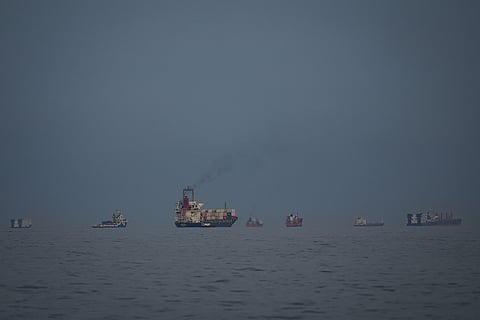
Dubai: Ships linked to Iran are increasingly adopting “ghost” tactics — going dark, spoofing identities and masking movements — in a bid to evade the US naval blockade in the Strait of Hormuz, signalling a shift toward more cautious and covert operations at sea.
Maritime intelligence experts say a noticeable change has emerged in recent days, with vessels manipulating tracking systems more aggressively than earlier in the conflict.
“Now, we are starting to see vessels going dark or using ‘zombie’ or random identification,” Ami Daniel, chief executive of maritime intelligence firm Windward, told The New York Times.
Under international maritime rules, large commercial vessels are required to operate transponders that broadcast their identity, location and route. But ships can switch off these systems or falsify data — a practice known as “spoofing” — effectively disappearing from radar or reappearing under altered identities.
Experts say these tactics mirror those used by Russia’s “shadow fleet” to evade sanctions after its 2022 Ukraine war, allowing it to sustain energy exports worth billions of dollars annually.
The shift suggests that operators of Iran-linked vessels are not just evading detection but also testing the practical limits of US enforcement in real time, as Washington tightens its blockade aimed at cutting off Tehran’s oil revenues.
By manipulating the global tracking system, these so-called “ghost ships” risk compounding confusion in one of the world’s most critical energy corridors, even if they ultimately fail to breach the blockade.
“Right now, the strait is a contested information environment,” Erik Bethel, a maritime technology investor, told the NYT, underscoring how deception is becoming central to the unfolding confrontation.
Shadow tactics at sea
Ships switch off transponders to disappear from tracking systems
Use fake or altered identities (“spoofing”)
Adopt “zombie” IDs mimicking other vessels
Borrow tactics from Russia’s shadow fleet
Aim to evade sanctions and enforcement
Create confusion in a high-risk global shipping lane
The development highlights a key vulnerability in the blockade itself. “A blockade is only as strong as the intelligence behind the interdictions,” Bethel said, pointing to the growing challenge of identifying which vessels to stop.
The complexity of maritime operations adds to the difficulty. Ships can be owned in one country, flagged in another and operated by entities elsewhere, making it extremely difficult to determine who is behind any given voyage.
Blockade breached
To track such activity, authorities rely on a combination of satellite imagery, radar systems and radio signals, supplementing standard transponder data.
Despite these evasive tactics, analysts say geography still favours US enforcement. The Strait of Hormuz — through which a significant share of the world’s oil and gas flows — is narrow, limiting the ability of vessels to slip through undetected.
US Central Command said no Iran-linked ships had successfully breached the blockade, with at least six merchant vessels turning back after being contacted by American forces.
More than a dozen US warships remain deployed east of the strait, enforcing the blockade from the Gulf of Oman and the Arabian Sea.
The emergence of spoofing and “ghost ship” tactics points to a broader shift in the conflict — from a conventional naval standoff to a more complex battle defined by data, deception and maritime intelligence.


