How one Iranian missile could trigger a US counterstrike
The high-stakes cat-and-mouse game behind a drone shootdown
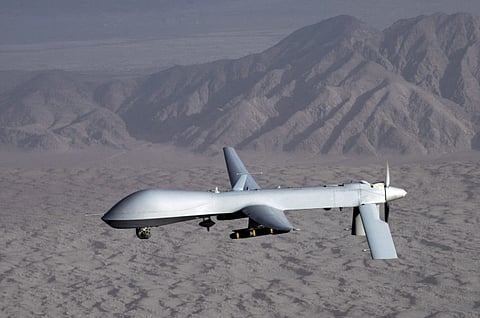
When a US surveillance drone is shot down by an Iranian missile, the immediate image is one of military success: a multimillion-dollar aircraft falling from the sky.
On Sunday (May 31, 2026), Iran's Islamic Revolutionary Guard Corps (IRGC) announced that its air defence forces shot down a $4-million MQ-1 Predator drone and fired at an "intruding" F-35 fighter jet over the Arabian Gulf.
Tehran claimed the aircraft violated its airspace.
The US military strongly denied the shotdown of the $100-million F-35, stating all assets remained "accounted for".
The Central Command, however, confirmed that an MQ-1 was shot down while it was operating over international waters.
This triggered "measured and deliberate strikes" on Saturday and Sunday in response to what it described as "aggressive Iranian actions".
Radar emissions
Modern warfare rarely ends with the first shot.
In this case, the process was initiated when Iranian air-defence radars detected and tracked an incoming aircraft such as the Predator drone.
Once a target is identified, radar operators relay coordinates to nearby surface-to-air missile (SAM) batteries, which can launch interceptors capable of striking drones operating at high altitudes.
How air defences are exposed
Yet destroying the drone may expose the air-defence system itself.
While the $4-million-apiece MQ-1 drone cruises at a relatively slower top speed of 217 km/h, Lockheed Martin's F-35 has a standard cruising speed of around Mach 0.9 (1,100 km/h), which tops out at over Mach 1.6 (1,930 km/h).
The MQ-1 drone, armed with Hellfire missiles, is specifically designed as a hunter-killer capable, loitering over battlefields for up to 24-hours.
The F-35 is a stealth multirole combat aircraft.
Electronic beacons
Following the MQ-1 shotdown, US fighter aircraft swiftly responded by hitting Iranian air defences, a ground control station, and two one-way attack drones that posed clear threats to ships transiting regional waters.
Military experts often describe active radar systems as electronic "beacons".
To track a target, a radar must emit radio waves that can also be detected by enemy aircraft, satellites and electronic intelligence systems.
Once those emissions are identified, they can reveal the radar's location.
That vulnerability has shaped US military doctrine for decades.
American forces employ anti-radiation missiles such as the AGM-88 HARM, specifically designed to home in on radar emissions.
Rather than targeting a vehicle visually, these weapons follow the radar signal back to its source, allowing aircraft to suppress or destroy enemy air defences.
Homing signals
The dynamic creates a dangerous cycle: air-defence operators must activate radars to engage incoming threats, but doing so can make them targets.
The strategic importance of such encounters is magnified in the Strait of Hormuz, the narrow waterway connecting the Arabian Gulf to the Gulf of Oman.
Roughly one-fifth of the world's seaborne oil trade passes through the chokepoint, about 33km at its narrowest, making any military confrontation there a matter of global concern.
Iran's 'layered' defences
Iran has long relied on a "layered" defence network that includes coastal missile batteries, naval forces, drones and radar installations positioned along the southern coastline and islands such as Qeshm overlooking shipping lanes.
The country also operates "swarms" of small, fast attack craft capable of harassing larger naval vessels and potentially laying naval mines.
The United States, meanwhile, maintains a substantial military presence in the region, including aircraft carriers, destroyers, surveillance aircraft and missile-defense systems.
US forces routinely conduct intelligence, surveillance and reconnaissance missions over international waters to monitor threats to commercial shipping and regional security.
Escalation
Military analysts note that drone shootdowns can quickly escalate because they provide valuable intelligence to both sides.
The defender demonstrates its ability to detect and engage targets, while the attacker gains information about radar frequencies, missile capabilities and command networks.
As tensions persist between Washington and Tehran, the shootdown of a single drone can become far more than an isolated incident.
It can trigger retaliatory strikes, expose military infrastructure, influence diplomatic negotiations and send shockwaves through global energy markets.
In the Strait of Hormuz, where military strategy and global commerce intersect, even a brief exchange of fire can have consequences far beyond the battlefield.


